|
AP Statistics Chapter 8 - Sampling Distributions
8.1: The Binomial Distributions
THE BINOMIAL SETTING
1. Each observation falls into one of just two categories, which for convenience we call “success” and “failure.”
2. There is a fixed number n of observations
3. The n observations are independent. That is, knowing the result of one observation tells you nothing about the other observations.
4. The probability of success, call it p, is the same for each observation.
BINOMIAL DISTRIBUTION
The distribution of the count X of successes in the binomial setting is the binomial distribution with parameters n and p. The parameter n is the number of observations, and p is the probability of success on any one observation. The possible values of X are the whole numbers from 0 to n. As an abbreviation we say that X is B(n, p).
BINOMIAL PROBABILITY
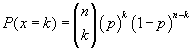
If X has the binomial distribution with n observations, and probability p of success on each observation, the possible values of X are 0, 1, 2, … n. If k is any one of these values,
MEAN AND STANDARD DEVIATION OF A BINOMIAL RANDOM VARIABLE
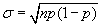
If a count X has the binomial distribution with n observations, and probability of success p, the mean (m) and standard deviation (s) of X are:

8.2: The Geometric Distributions
THE GEOMETRIC SETTING
1. Each observation falls into one of just two categories, which for convenience we call “success” and “failure.”
2. The probability of success, call it p, is the same for each observation.
3. The observations are all independent.
4. The variable of interest is the number of trials required to obtain the first success.
GEOMETRIC PROBABILITY
If X has the geometric distribution with probability p of success and (1 – p) of failure on each observation, the possible values of X are 1, 2, 3, …. If n is any one of these values, the probability that the first success occurs in the nth trial is

MEAN OF A GEOMETRIC RANDOM VARIABLE
If X is a geometric random variable with probability of success p on each trial, then the mean (m) of X (also called the expected value of X) is:

P(X>n)
The probability that it takes more than n trials to see the first success in a geometric setting is,

|

