Chapter 4 Practice Free Response - Answers
1. The
productivity of American agriculture has grown rapidly due to improved
technology (crop varieties, fertilizers, mechanization). Here are data on the output per hour of labor
on American farms. The variable is an
“index number” that gives productivity as a percent of the 1967 level.
Year Productivity Year Productivity
1940 21 1965 91
1945 27 1970 113
1950 35 1975 137
1955 47 1980 166
1960 67 1985 217
You will now examine whether an
exponential model is appropriate for the growth of productivity over time. Be
sure to let 1940 = 0, and all other years are set as years since 1940.
a. Perform
an appropriate logarithmic transformation on this data. Then do a linear
regression on this transformed data and give the values of “a” and “b” for the
regression.
Original Data Transformed Data Regression
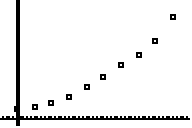
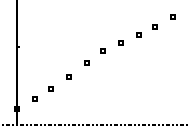
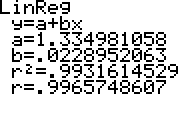
b. Use the results of
part (a) to determine the coefficients of the exponential model (A and B). Also
write the exponential function that results from these
coefficients.
A = 10a
= 101.335 = 21.63 and B = 10b = 100.023 =
1.054, so y = 21.63(1.054)x
c. Using a residual plot, determine whether an exponential model is appropriate for this data. Explain your reasoning.
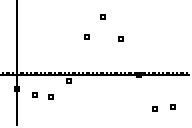
This residual plot seems to show a pattern;
therefore the data does not accurately follow an exponential growth pattern.
2. Over
the past 30 years in the
a. Draw
a diagram of the relationship and identify all variables.
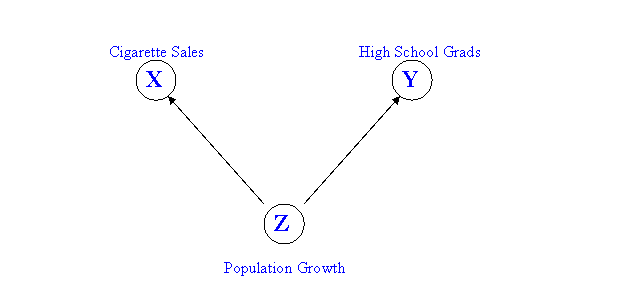
b. The
statement prior to #10 represents (circle the correct answer):
causation common response confounding
3. A
1969 study among the Pima Indians of Arizona investigated the relationship
between a mother’s diabetic status and the appearance of birth defects in her
children. The results appear in the
two-way table below.
Diabetic Status
Birth
Defects Nondiabetic Prediabetic Diabetic
None 754 362 38
One
or more 31 13 9__
a. Fill
in the row and column totals in the margins of the table.
Diabetic Status
Birth
Defects Nondiabetic Prediabetic Diabetic
None 754 362 38 1154
One
or more 31 13 9__
53
785 375 47
b. Compute
(in percents) the conditional distributions of birth defects for each diabetic
status.
|
Nondiabetic |
Prediabetic |
Diabetic |
|
31 / 785 = 4% |
13 / 375 = 3% |
9 / 47 = 19% |
c. Comment on any clear associations you see.
Mothers who are diabetic are much more likely
to have children with birth defects.